ERA5 atmospheric reanalysis
ERA5, the successor to ERA-Interim, provides global, hourly estimates of atmospheric, ocean-wave and land-surface variables, at a horizontal resolution of 31 km and 137 levels in the vertical from the surface to 0.01 hPa (about 80km). Produced by ECMWF on behalf of the European Union’s Copernicus Climate Change Service (C3S), ERA5 extends from 1940 onwards. Each day one new day is added, five days behind real time such that ERA5 provides a long record up to a few days ago such that it allows for timely monitoring of the climate. In addition, ERA5 is used for e.g., the study of specific historical events, low-frequency variability and extremes in climate studies and for the initialization, provision of boundary conditions or driver for other models. ERA5 is also progressively used as a big dataset for machine learning applications.
ERA5 represents 10 years of progress made in modelling and data assimilation since the production of ERA-Interim. The numerous improvements and advances are discussed in the Expert Guidance and the cited literature. Although this is an extraordinary and very widely used product, users still need to be aware of the limitations of reanalysis; the major one that non-physical trends and variability may be present in the record of some variables due to an undesired interplay between systematic model bias and changes in the observing system.
ERA5 contains a 3-hourly uncertainty estimate at half the resolution that indicates where and when ERA5 is dominated by observations and therefore likely trustworthy on the synoptic level and where it is more controlled by underlying physical model which, when the effect of systematic model error is limited can still provide information on low-frequency variability. The evolution of this uncertainty estimate illustrates the enormous improvement of the ingested observing system (and therefore the quality of ERA5) over time with only surface observations in the 1940s (mostly over the northern hemisphere), the availability of upper-air observations from the mid 1940s and the start of the availability of large numbers of satellite observations from the end of the 1970s.
Due to stratospheric temperature biases from the years 2000-2006 that were present in the first version of ERA5, ECMWF have published an improved dataset, ERA5.1 for these years, which should be used to replace ERA5 for stratospheric studies where the atmospheric mean state matters. Please see the Simmons et al (2020) reference for details. According to Simmons et al. 2020: "ERA5 and ERA5.1 perform very similarly in the lower and middle troposphere."
Key Strengths
Integrator of large volumes of observations providing a spatially and temporally complete data set of multiple variables at high spatial (31km) and temporal (hourly) resolution. Produced in near real time with a latency of about 5 days.
More accurate representation of the actual historical atmospheric circulation, features like tropical cyclones, the hydrological cycle and energy budgets than previous generations of ECMWF reanalysis.
Availability of an uncertainty estimate from an Ensemble of Data Assimilation (EDA) Systems at half the resolution which guides when and where ERA5 is dominated by observations and when it more represents the model climate.
Key Limitations
Non-physical trends and variability may be present in the record due to changes in the observing system; this is mainly an issue in the upper stratosphere and mesosphere.
Several variables such as e.g., near-surface winds show (small) systematic jumps at 10UTC and 22UTC due to the design of the 12-hourly assimilation windows from which the time evolution of the hourly product is sampled.
The ERA5 ensemble spread is likely under dispersive giving too high confidence. (Please see the Expert Guidance below, and the references cited therein, for additional strengths and limitations.)
Hersbach, H., and Coauthors, 2020: The ERA5 global reanalysis. Q.J.R. Meteorol. Soc., 146, 1999–2049, https://doi.org/10.1002/qj.3803.
Expert Developer Guidance
The following was contributed by Dr. Hans Hersbach, June, 2023:
Introduction
ERA5 is the 5th major atmospheric reanalysis produced by ECMWF, following the FGGE reanalysis, ERA-15, ERA-40 and ERA-Interim. The ERA5 dataset provides hourly data on surface and upper-air parameters at roughly 31 km global resolution on 137 levels reaching up to 1 Pa. It also includes the 10 members from the ensemble 4D-Var data assimilation system used to produce the reanalysis, at reduced (3-hourly, 63 km) resolution.
ERA5 data are available from January 1940 onwards. Each day one new day is added that is 5 days behind real time. Data less than three months old can be changed in case large issues are found. So far, this has only occurred once in the fall of 2021 when poor quality control of snow observations from some stations in Central Asia had led to locally degraded 2m temperature and soil moisture. In that occasion the issue was resolved in time such that the final product was corrected within the given latency of three months.
ERA5 is a product of the Integrated Forecast System (IFS) release 41r2, which was operational at ECMWF during the period March-November 2016. This IFS release represents 10 years of progress on modelling and data assimilation at ECMWF since the production of ERA-Interim. Numerous model improvements were implemented during this time, many of them leading to major advances in the ability to assimilate satellite data in cloudy and rainy conditions. They include a complete overhaul of the radiation scheme, new treatment of large-scale clouds and precipitation, and the introduction of prognostic variables for precipitating rain and snow. Model boundary conditions and radiative forcing data compatible with CMIP5 recommendations were implemented to support climate reanalysis. These and many other advances relevant to reanalysis are documented in Hersbach et al. 2020, which also describes details of the design of the background error covariances used, observation quality control, bias correction schemes, an overview of all ingested observations and forcing datasets plus a basic evaluation of characteristics and performance.
Strengths
Some key improvements in ERA5 relative to ERA-Interim are:
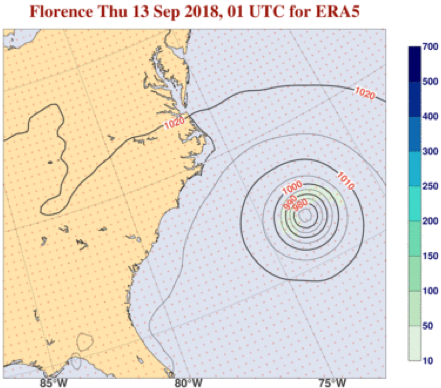
- Higher temporal and spatial resolution. This is evident in the representation of extreme weather events such as hurricane Florence in September 2018 (Figure 1).
- Available from 1940 onwards with daily updates close to real time.
- Better representation of tropospheric circulation throughout the modern observing period from 1979, as indicated by the evolution of forecast skill in Figure 2 (from Bell et al., 2021).
- Availability of an uncertainty estimate from the spread in a 10-member ensemble of 4D-Var data assimilation system at half the resolution.
- Improved temporal consistency due to assimilation of many newly reprocessed satellite data records.
- Assimilation of data from many recent instruments, including IASI, ASCAT, CrIS, MWHS, MWHS-2, TMI, SSMIS, AMSR-2, GMI.
- Improved response to major volcanic eruptions such as Pinatubo thanks to taking account of the corresponding evolution of volcanic sulphate.
- Modest improvements in global radiation budgets, mainly due to improved model data, although net absorbed energy at the surface is still too large.
General strengths:
- Integrator of large volumes of observations providing a spatially and temporally complete data set of multiple variables at high spatial (31km) and temporal (hourly) resolution.
- More accurate representation of the actual historical atmospheric circulation, features like tropical cyclones, the hydrological cycle and energy budgets than previous generations of ECMWF reanalysis.
- Availability of an uncertainty estimate from an Ensemble of Data Assimilation (EDA) Systems at half the resolution which guides when and where ERA5 is dominated by observations and when it more represents the model climate.
- Maintained close to real time with a latency of 5 days. Up to current date ERA5 ingests observations from nearly all sources (in-situ and satellite) that are also used in the ECMWF operational NWP system.
Weaknesses
Changes in the observing system and the production of segments in separate, parallel streams can result in unrealistic trends and variability in reanalysis data, especially where observation coverage is insufficient to constrain biases in the assimilating model. Figure 3 (from Bell et al., 2021) illustrates several unrealistic jumps in stratospheric temperature above 10 hPa. The low-frequency variability of temperature in the lower stratosphere and troposphere, however, does show the correct response to major volcanic eruptions in the lower stratosphere and evolution of the El Niño-Southern Oscillation (ENSO). The behaviour of upper-air ozone anomalies is quite different and purely model-based in the ERA before the availability of satellite observations, while jumps appear in stratospheric humidity at some transition points between production streams.
Some shifts in tropospheric humidity over oceans associated with the introduction of microwave imager data in the 1990s are still present in ERA5, although to a much lesser extent than in ERA-Interim.
The information provided by the 10-member ensemble 4D-Var can be useful as an indicator of state-dependent uncertainties but should be used with care. Preliminary analysis of spread-skill relationships suggest that the ensemble is generally under-dispersive, i.e,. the uncertainties tend to be underestimated.
- As mentioned earlier, global-mean energy fluxes in ERA5 are slightly better than in ERA-Interim but still do not close correctly.
General limitations:
- Non-physical trends and variability may be present in the record due to changes in the observing system; this is mainly an issue in the upper stratosphere and mesosphere.
- Several variables such as e.g., near-surface winds show (small) systematic jumps at 10UTC and 22UTC due to the design of the 12-hourly assimilation windows from which the time evolution of the hourly product is sampled.
- The ERA5 ensemble spread is likely under dispersive giving too high confidence.
- ERA5 suffers from an overly strong equatorial mesospheric jet, particularly in the transition seasons.
- Discontinuity in stratosphere humidity and deep soil moisture at some of the transition points between production streams that were conducted in parallel to speed up the production.
- Some issues with the sea surface temperature (SST) and sea ice cover such as the presence of ship tracks in SST prior to 2007, inconsistencies over the Great Lakes and the Caspian between 2007 and 2014, lack of sea ice cover north of Greenland between 1979-1989.
- Warm bias of about 5K in the Arctic sea-ice surface temperature during winter.
Reanalysis as an operational service
ERA5 is the first reanalysis produced by ECMWF as an operational service rather than a research project. The development, production, data storage, data access and user support services for ERA5 are fully funded by the European Union under the Copernicus Earth Observation Programme. Climate reanalysis is a central element of the Copernicus Climate Change Service, which is implemented by ECMWF on behalf of the European Commission.
Incorporation within the Copernicus programme of reanalysis activities (including fundamental work on input observations) ensures sustainable development of future reanalyses as well as improved data access under free and open data policies.##
Cite this page
Acknowledgement of any material taken from or knowledge gained from this page is appreciated:
Hersbach, Hans & National Center for Atmospheric Research Staff (Eds). Last modified "The Climate Data Guide: ERA5 atmospheric reanalysis.” Retrieved from https://climatedataguide.ucar.edu/climate-data/era5-atmospheric-reanalysis on 2026-06-03.
Citation of datasets is separate and should be done according to the data providers' instructions. If known to us, data citation instructions are given in the Data Access section, above.
Acknowledgement of the Climate Data Guide project is also appreciated:
Schneider, D. P., C. Deser, J. Fasullo, and K. E. Trenberth, 2013: Climate Data Guide Spurs Discovery and Understanding. Eos Trans. AGU, 94, 121–122, https://doi.org/10.1002/2013eo130001
Key Figures
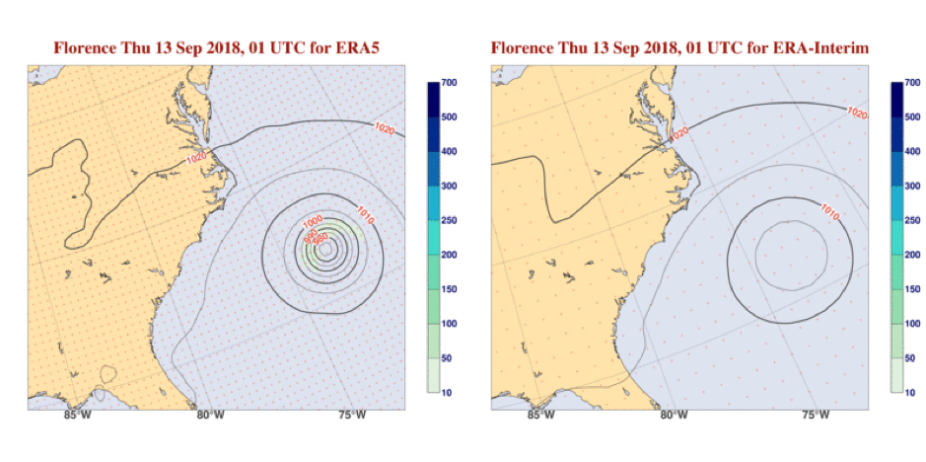
Figure 1: Representation of hurricane Florence (September 2018) in ERA5 (left) and ERA-Interim (right). (contributed by D Dee)
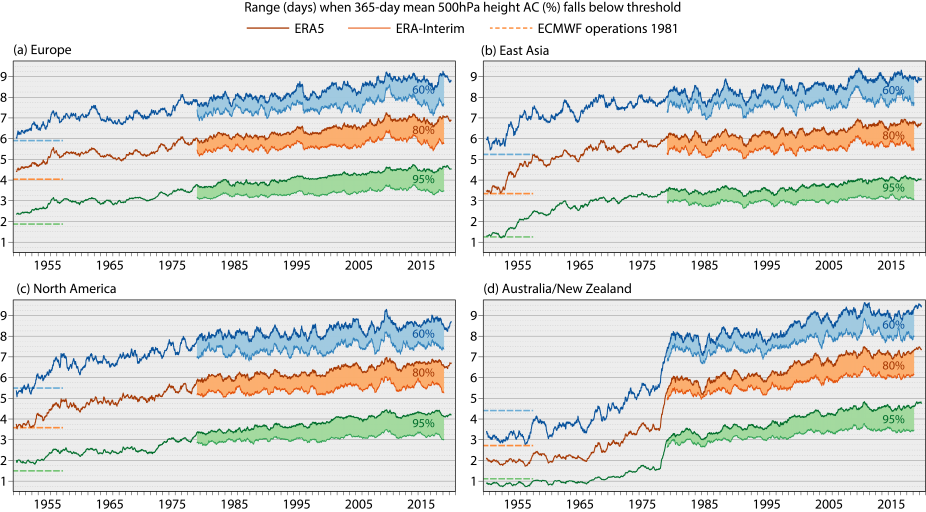
Range (days) at which running 365-day mean anomaly correlations of 500 hPa height forecasts at 0000 and 1200 UTC from 1950 to 2020 reaches 95% (green), 80% (orange) and 60% (blue) for (a) Europe, (b) East Asia, (c) North America and (d) Australia/New Zealand. Also shown (dashed) is the average skill of ECMWF operational forecasts for 1981. Heavy lines denote ERA5; thin lines denote ERA-Interim. Shading denotes the difference between ERA5 and ERA-Interim during the period for which both are available (1979–2019)(Adapted from Bell et al (2021); contributed by H. Hersbach)
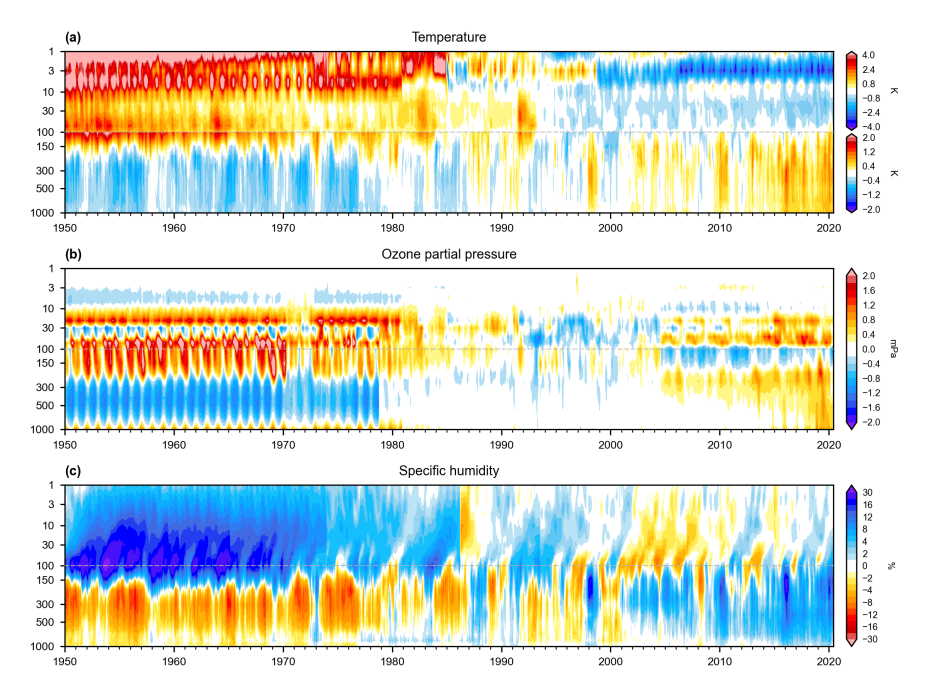
ERA5 monthly and globally averaged upper-air anomalies with respect to the 1981–2010 monthly climatology for (a) temperature, (b) ozone partial pressure and (c) specific humidity during the period 1950–2020. The period from January 2000 to December 2006 is based on ERA5.1. Anomalies for specific humidity are shown in per cent of the 1981–2010 monthly climatology. For temperature, note the different colour scales used above and below 100 hPa (Adapted from Bell et al (2021); contributed by H. Hersbach)
Other Information
- Bell, B., and Coauthors, 2021: The ERA5 global reanalysis: Preliminary extension to 1950. Quart J Royal Meteoro Soc, 147, 4186–4227, https://doi.org/10.1002/qj.4174.
- Hersbach, H., and Coauthors, 2020: The ERA5 global reanalysis. Q.J.R. Meteorol. Soc., 146, 1999–2049, https://doi.org/10.1002/qj.3803.
- Simmons, A., and Coauthors, 2020: Global stratospheric temperature bias and other stratospheric aspects of ERA5 and ERA5.1. ECMWF, https://doi.org/10.21957/RCXQFMG0.