BAMS State of the Climate
Climate data guide content with tag BAMS State of the Climate
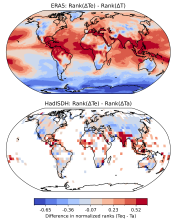 Equivalent Temperature: HadISDH.land and ERA5
Years of record
- to
Equivalent temperature is a measure of heat in the atmosphere that accounts for the latent heat stored in water vapor in addition to sensible heat as measured by temperature. The equivalent temperature ($T_e$) scales linearly with the moist enthalpy (i.e., the temperature and humidity) of the atmosphere. Te is computed from: $$T_e = T + \frac{L_v}{C_p} q \tag{1}$$ in…
-
Formats
- N/A
-
Timestep
- Monthly
-
Domain
- Global
-
Collections
- BAMS State of the Climate
Experts contributing reviews
- Matthews, Tom
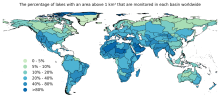 Lake Water Storage: GloLakes
Years of record
- to
Lakes and reservoirs are critical components of the hydrological cycle, particularly due to their central role in many human systems. Long-term measurements of lakes is critical for understanding the dynamics linking lake volume to the climate system and human activities. The GloLakes dataset utilities remote sensing data to provide near real-time monitoring of the…
-
Formats
- N/A
-
Timestep
- Monthly
-
Domain
- Global
-
Collections
- BAMS State of the Climate
Experts contributing reviews
- N/A
- Night Marine Air Temperature (NMAT) Datasets: CLASSnmat and UAHNMATv1
Years of record
- to
Night Marine Air Temperature (NMAT) refers to measurements of air temperature recorded with thermometers on the weather stations of ships. NMAT is a highly correlated variable with Sea Surface Temperature (SST), capturing the temperature of the atmosphere near the surface. The earliest known record of NMAT begins in 1699 with records expanding globally by the mid-1800s…
-
Formats
- netCDF
-
Timestep
- Monthly
-
Domain
- Global
-
Collections
- BAMS State of the Climate
Experts contributing reviews
- Cornes, Richard
- Observational Data in BAMS State of the Climate
Years of record
The Bulletin of the American Meteorological Society (BAMS) publishes a report known as the BAMS State of the Climate each year detailing the state of the climate over the previous year. This annual assessment began in 1996 and serves as a comprehensive and accessible resource for state-of-the-art and current observations of the Earth system. The 2024 report was written…
Main variables and Earth System components
N/A-
Formats
- N/A
-
Timestep
- N/A
-
Domain
- N/A
-
Collections
- BAMS State of the Climate, Overview / Comparison page
Experts contributing reviews
- N/A
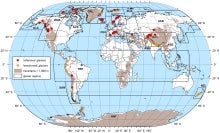 Observations of Glacier Mass Balance: The World Glacier Monitoring Service
Years of record
- to
Mountain glaciers and ice caps have been studied as sensitive indicators of climate since the 19th century. The recognition of glacier sensitivity to climate led to the development of a global reporting system for glacier terminus change and glacier mass balance during the International Geophysical Year. The World Glacier Monitoring Service (WGMS) has been the…
-
Formats
- N/A
-
Timestep
- Annual
-
Domain
- Global
-
Collections
- BAMS State of the Climate
Experts contributing reviews
- Pelto, Mauri
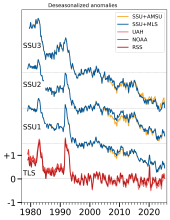 Stratospheric Temperature: Satellite Datasets Used to Quantify Lower, Middle, and Upper Stratospheric Temperatures
Years of record
- to
The temperature of the stratosphere is a key climate variable for understanding variability and change of the Earth's radiation budget, particularly due to sensitivity to changes in stratospheric ozone as well as aerosols from volcanoes and wildfires. While there are direct measurements of the lower stratosphere with weather balloons and field campaigns, complete…
-
Formats
- N/A
-
Timestep
- Monthly
-
Domain
- Global
-
Collections
- BAMS State of the Climate
Experts contributing reviews
- Randel, Bill, Starr, Jon
 Total Column Water Vapor: Integrated Water Vapor from GNSS stations
Years of record
- to
Total Column Water Vapor (TCWV) or Integrated Water Vapor (IWV) is a key measure of the quantity of moisture held in the atmosphere at given locations. Water vapor is a key variable for understanding the moist energetics of the atmosphere and therefore the circulation as well as the radiative properties due to its strong absorption at most frequencies in the long-wave…
-
Formats
- ascii
-
Timestep
- Sub-daily, Daily, Monthly
-
Domain
- Global
-
Collections
- BAMS State of the Climate
Experts contributing reviews
- N/A